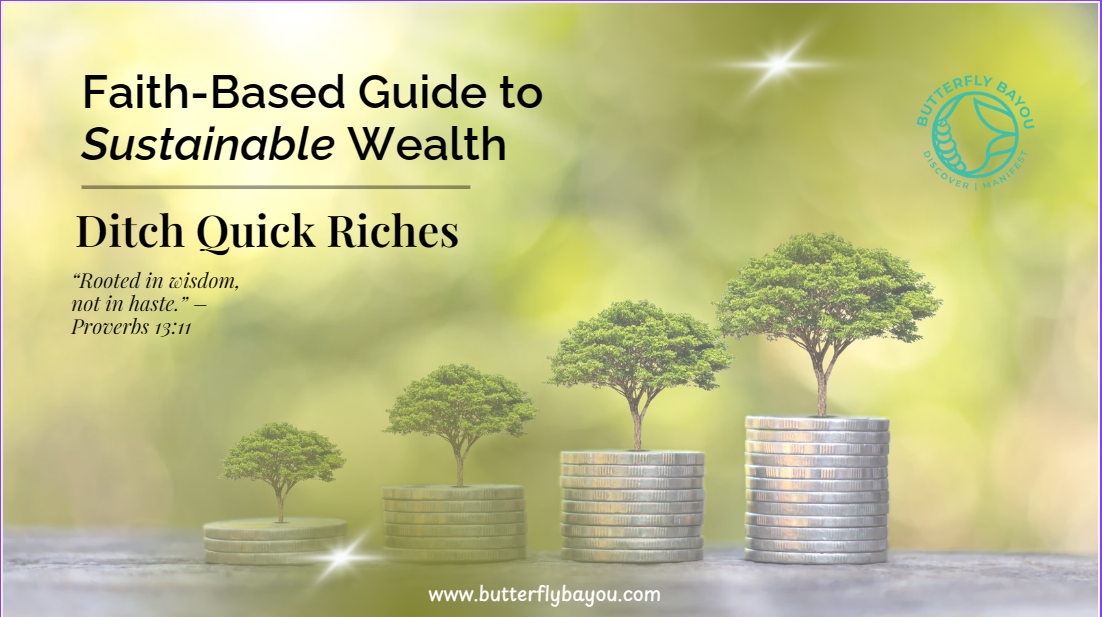
This month, our focus is on financial goals. I developed this faith-based guide to sustainable wealth. How should we approach wealth creation without falling into the trap of get-rich-quick schemes?
A while back, a lady called into the Dave Ramsey Show to seek financial advice on how to manage a $300,000 loss incurred via day trading. Here is the kicker: between her and her husband, their total annual earning is $38,000. A stunned Dave Ramsey asks, “Where Did You Have $300K That You Could Lose?” As it turns out, it was an inheritance windfall burned through a game of chance. Does this mean that day trading and other such means of wealth creation are bad? Good or bad are not definitive. What is bad is the lure of instant wealth.
Why This Faith-Based Guide to Sustainable Wealth Matters Today: Instant Wealth Is So Tempting
Economic Pressure and the Illusion of Quick Solutions. Multiple factors are cutting into disposable income: inflation, shrinkflation, tariffs, rising living costs and standards, and more. It is natural that we want to get the most out of every dollar and dime. We want to compound whatever available resources there are. This trigger is worth recognizing as a legitimate concern.
Consumerism and the Cost of Keeping Up. This refers to a culture where people’s identity is largely built on the acquisition and consumption of goods and services, especially following the trend or pop culture. While consumer spending drives economic growth, excessive consumer spending is often related to societal ills such as increased consumer debt, unsustainable lifestyles which often leads to pain and breakdown of families, and other vices from petty theft to outright fraud.
The God-Honoring Path to Building Wealth | Faith-Based Guide to Sustainable Wealth
God Is Our Provider—Not Get-Rich Schemes. Whenever I am faced with a tough decision, I ask myself, what is God’s wisdom on this matter? For me, God’s wisdom when it comes to building wealth is consistently setting in my heart the fact that God is Our Provider. When faced with the pressure to multiply wealth to meet your needs, be reminded that God is our provider. In Matthew 6:26, Jesus says, “Look at the birds of the air: they neither sow nor reap nor gather into barns, and yet your heavenly Father feeds them.” Then He follows with a rhetorical question, “Are you not of more value than they.”
Does this passage call us to be slothful, fold our arms and expect to be fed? Certainly not. The birds of the air do not do that. Birds have developed ways of preparing for season changes and for gathering their food, including learning and observation (which includes utilizing visual and sound cues), and social learning (observing their peers); and food storage (developing techniques to preserve food for the rainy day). So, no, seeing God as our provider is not about folding our arms and being slothful. Rather, it is about confidence in His ability to provide so much so we are inspired to take action and trust that God will enrich us through His gifting in us. Seeing God as our Jehovah Jireh, our provider, also builds a heart of contentment because, we no longer look onto ourselves but onto Him and we find joy in plenty or little.
Planning with Diligence: Lessons from the Ants. After establishing the fact that God is our provider, the next step is to define the how to our goal. Already established is the fact that the desire to build and multiply wealth is not wrong. What is wrong is how it is approached. A get-rich-quick scheme is sure to lead to sudden losses. To forestall this, we ought to plan diligently. The writer of Proverbs 6:6 says, “Go learn from the ants and be wise.” What are the attributes of ants to consider?
- Diligence and hard work
- Preparation for the future
- Teamwork and cooperation
- Resourcefulness
- Wisdom and foresight
No one is born with these personality traits and in a fast-paced world of instant everything, these attributes get lost in the rush of our daily experiences. But to build sustainable wealth, there is no shortcut.
Now that we have established how we should approach the subject of wealth creation or financial health, let us look at the common get-rich-quick schemes.
The Most Common Instant Wealth Traps
- Day Trading and High-Risk Investing
- Flipping Houses Without Expertise
- MLM and Direct Marketing Pitfalls
- Life Insurance Sales—When It Turns into a Scheme
- Digital Marketing Hype
Of great note is the fact that these are all legitimate means of creating wealth, building a career, providing for one’s family and build wealth without compromising your faith. All of these can indeed lead to great profit. But they are also some of the common avenues for luring people into instant wealth. So, when approached by someone inviting you to invest your time and money in these trending instant wealth schemes, look out for the following:
- A promise of easy profit. No, profit is not easy. The analogies we looked at earlier focus on diligence, hard work and insight. These are attributes that are developed over the passing of time.
- Downplaying the risk and difficulty. Ever seen something like this, “I used to be a teacher (or anything else) but I started day trading 2 months ago and all I have to do is work four hours a week and I am now making $10,000 (or whatever ridiculous amount) monthly. Such comments are not uncommon in Facebook groups and other online forums where these recruiters go to seek easy prey. Does this mean day trading is bad? Absolutely not. But downplaying the risk and difficulty is a sign that you are being drawn into an opportunity not right for you or you might not be prepared for.
- A lack of transparency. Anyone who is introducing you into something legitimate should have the confidence to speak openly about it. Asking you to “DM for details” is often a sign of seeking a way to gain direct access to you for increased pressure and spread of misinformation. A legitimate business should be conducted in the open.
- Requiring continued investment. These programs often require you to continue to make periodic, often monthly, investments to remain in good standing, still with the promise of wealth without a defined path. Some rely on your ability to recruit friends and families rather than selling a valid value proposition to attract true business.
Again, to stress, none of these are in or of themselves bad. As a licensed life and health insurance agent, for example, I like the fact that I can help folk prepare for life’s eventualities through products that help to protect their most important relationships and assets. But what I will not do is get tied up in any scheme, or lure anyone into a scheme that requires them to put pressure on their friends and families to keep it going.
So, how do we approach wealth-building opportunities without falling into the trap of instant wealth and mortgaging our resources and relationships?
How to Build Sustainable Wealth Without Compromising Your Faith
- Align with Your Gifts and Interests. Are you particularly knowledgeable in an area? Do you even have a general liking for the subject? A few years ago, I was selling clothes in online stores. I did not do badly but I knew I was not maximizing my time. Why? Well, don’t ask me about my fashion interest. Suffice to say, I think of fashion in a more functional sense. So, I am no Gabrielle “Gaby” Solis. After much thought, I accepted the fact that I was not playing in my area of strength. I saw an opportunity and went in but did not have enough interest to dig deeper. Opportunity and interest should come together.
- Build Insight through Learning and Mentorship. Insight can be gathered through mentorships, educational programs, internships and apprenticeships, observation and deep learning. Did you know that ecommerce giant, Amazon, started with by selling books? Why is that? He just liked books so much, had a passion for books and went for it? Far from it. Jeff Bezos had a list of options but developed deep insight into the opportunities, developed the pros and cons and settled for books. So, after identifying your interests, develop deep insights and come up with a game plan.
- Evaluate Real Risks vs. Promises. There is no shortcut to success. In fact, we are living in an age of boundless knowledge. Want to learn something, anything? All you need is a phone and the internet. Well, there is a lot of garbage there, just like junk food, but when you sift through the garbage, you will find the organic or natural side of YouTube. There is Udemy, Coursera and other low cost and free platforms of learning available today.
- Use Free Tools Like MOOCs and YouTube. As a generalist, I have dabbled into many things. I am not sure why or how I developed into a generalist but perhaps my time as a communications specialist introduced me to so many domains, I just kept taking it all in as a sponge. So, to affirm my plan of attack, I audit my interest. For example, after some time as a sales data analyst, I tried a few systems analyst courses, tried some finance courses and was able to establish my interest in finance over the others. We are especially blessed in a generation where Massive Online Open Courses (MOOCs) and YouTube are available for us to get that initial knowledge to sort of guide our decision making (I will write about MOOCS in a future blog post).
Final Thoughts: Get Help to Get Started
If you have read it up to this point, well done! I hope this post has provided clarity on the faith-based guide to sustainable wealth. I’d like to know your thoughts. Feel free to write to me with comments and questions.
I also want to invite you to join the Butterfly Bayou growth community. Butterfly Bayou is a faith-inspired women’s focused growth community founded to help women build, balance and thrive. You are welcome to join our growth community, join the book club or schedule a one-on-one session with me for personal development coaching. If you are not ready to join the growth community just yet, feel free to sign up for our monthly newsletter for regular updates.
My vision is to create a God-honoring community where women can discover and develop their talents through meaningful, balanced, and purpose-driven work with godly insight.